Copyright © Hans Högman 2025-12-29
A brief overview of Swedish
history
Introduction
The following historical section is by no means
complete from a historical perspective.
The purpose of this page is to provide a
chronological historical overview of events in
Sweden that may have had a connection with or
impact on the lives and livelihoods of my and others’
Swedish ancestors.
Swedish History in
Brief (1900s-2)
Related Links
•
Swedish history - 1500s - 1600s
•
The Reformation and King Gustav I
•
Swedish history - 1700s
•
Swedish history - 1800s
•
Swedish history - Part 1
•
Swedish history - Part 1
•
The New Sweden Colony in North America
•
Swedish Witch Trials
•
The Allotment System
•
Swedish School System
•
Swedish Banking
•
Swedish Monetary System
•
History of the Swedish Police System
•
Poor Relief in the past
•
Health Care and Diseases in the Past
•
The Many Swedish Wars
•
Swedish Inventions
•
Inns and Stage Services
•
History of Railways in Sweden
•
History of Church of Sweden
•
History of the Swedish Riksdag (Parliament)
Source References
•
Wikipedia
•
Svenska krig 1521 – 1814. Ulf Sundberg, 1998
•
Svenska freder och stillestånd 1249 - 1814, Ulf
Sundberg, 1997
•
Ånga och Dynamit, Historien om Sverige,
Herman Lindqvist, 1999
•
När Sverige blev stormakt, Historien om Sverige,
Herman Lindqvist, 1994
•
Ofredsår, Peter Englund, 1993
•
Trolldomsprocesserna i Sverige av Bengt
Ankarloo, 1996.
Top of page
1900s - Part 2
The 20th century began somewhat dramatically for
Sweden with the dissolution of the union with
Norway in 1905.
Furthermore, the military allotment system (with its
standing army) was abolished in 1901 in favor of a
conscript army, i.e., universal conscription. The 20th
century also saw two major conflicts: World War I
and World War II.
Swedish Vacation Entitlement
The first legislation in Sweden regarding vacation
entitlement was enacted in 1938. Under this law, all
employees were entitled to two weeks of vacation.
Vacation duration was increased to three weeks in
1951 and four weeks in 1963.
The current law dates from 1977 (1977:480) and took
effect in 1978. At that time, vacation entitlement was
extended to five weeks.
The Vacation Act governs the annual leave, annual
leave pay, and annual leave compensation. Any
agreement that provides the employee with benefits
less favorable than those stipulated by law is invalid.
Employees who are entitled to more than 20 days of
annual leave may carry over any unused days for
up to five years and then take them as a single
block of time off. If operational circumstances
permit, the law allows them to accumulate ten weeks
of leave once every six years. Saturdays and Sundays
are not normally counted as vacation days.
The length of the statutory vacation is a minimum
requirement. Today, many people have vacations
lasting six or seven weeks under their
employment contracts.
Similarly, people took vacations even before they
became statutory in 1938, including those in lower-
paying jobs.
In Sweden today, the statutory vacation is 25 working
days. However, the law is discretionary, and it is
therefore permissible to agree on a longer vacation
than the minimum requirement specified by law.
For more information, visit the page: Swedish
Vacation Entitlement
The History of Pensions in Sweden
It was only a little over 100 years ago—in 1913, to be
precise—that we established a pension system
covering all citizens: the universal pension insurance.
Various pension systems existed even before 1913,
but they operated differently for different groups.
For the vast majority of people in the past, poor relief
was the norm once they were no longer able to work.
On May 21, 1913, the Swedish Parliament passed a
resolution to introduce a universal pension
insurance system that covered virtually the entire
population. Sweden thus became the first country in
the world to introduce a universal pension insurance
system.
As early as 1884, the Riksdag appointed a “Workers’
Insurance Committee.” The proposals put forward by
this committee set in motion a process of social
policy legislation that led, among other things, to the
Occupational Safety Act of 1889, support for health
insurance funds in 1891, accident insurance in
1901/1916, and finally the Pension Insurance Act of
1913.
Under the decision, the pension would cover the
entire population and would be paid to anyone who
was unable to work or had reached the age of 67.
The pension system consisted of two
components: a contribution-based insurance
component and a grant component.
The immediate outcome of the pension reform was
the transfer of the elderly poor and disabled
individuals from the poor relief system to the
pension system. The pension amount under the
universal pension insurance scheme was low, making
it challenging for many individuals to sustain
themselves on their pension.
In 1914, the Pension Board was established as a new
national agency to manage and record contributions
to the pension insurance system.
The 1936 pension legislation amended the 1913 Act,
but the basic structure remained unchanged. It
continued to be a two-part system, consisting of a
basic pension based on contributions paid and an
income-dependent pension supplement.
The national basic pension (Swedish: Folkpension)
was no longer based on a defined-contribution
system. Everyone was required to pay a contribution
to the national treasury. The supplements were
altered so that anyone earning a modest income and
over the age of 67 might get a pension supplement.
Under the 1936 pension reform, the pension thus
consisted of a basic pension (Swedish grundpension),
which was paid as a fixed amount that was the same
for everyone, and a supplementary pension
(Swedish: tilläggpension), which depended on the
contributions paid. The reform took effect in 1937.
Various objections were raised against the universal
pension insurance system, including the claim that it
discriminated against women. The Riksdag passed a
resolution on a national basic pension in 1946, and
it was introduced in 1948.
It consisted of a basic amount (Swedish:
grundbelopp) and a means-tested housing
supplement.
With the national basic pension reform, the practice
of differentiating pensions based on gender was
abandoned.
As a result of the 1946 national pension reform and
several supplementary decisions in the early 1950s,
the national basic pension was structured in such a
way that old age was no longer a cause of poverty.
The indexation of pensions in 1950 and the
introduction of municipal housing supplements in
the mid-1950s brought pensioners’ basic financial
security up to a reasonable level.
A third pension committee was appointed in 1956.
To move the issue forward, the government decided
to hold an indicative referendum on October 13,
1957. Three proposals were put to a vote in the
referendum, and Option 1 received the most votes.
Proposal 1: A universal and mandatory
occupational pension (Swedish: tjänstepension)
funded by employer contributions (Swedish:
arbetsgivaravgifter). The pension should be
proportional to income earned during one’s working
life, and the fund assets should be managed by a
board appointed by the government and
representatives of employers and employees.
The Social Democratic Party did, however, propose a
proposal (Proposal 1) in Parliament, which was
defeated in the Second Chamber.
In the final vote in the Parliament on May 14, 1959,
the Act on the Universal Supplementary Pension
(Swedish: Allmän Tillägspension—ATP) passed by a
single vote.
The system consisted of a basic pension—the
national basic pension (folkpension), which was the
same for everyone—and an income-based
supplementary pension, the ATP.
The ATP system went into effect on January 1, 1960.
On July 1, 1976, the retirement age was lowered to
65.
The Swedish Parliament decided in 1994 and 1998
on a major pension reform that came into effect in
1999. The reason was that a completely benefits-
based pension system was too costly. Instead, a
contribution-based system was chosen. In the new
system, the pension is based partly on lifetime
income and partly on paid premiums.
The new pension system, the universal pension
(Swedish: allmänna pensionen), consists of the
income-based pension, the premium pension, and
the guaranteed pension.
For more information, visit the page: The History of
Pensions in Sweden
Personal Identity Numbers Introduced in
1947
Every Swedish citizen has a unique personal
identity number (PIN). It is also known as “Citizen's
Codes.” In Sweden, the term is “personnummer.”
A personal identification number is a unique identifier
for individuals. The personal identification number
system was introduced in Sweden in 1947.
Individuals born before 1947 were assigned a
personal identification number in the county where
they were living at the time.
Everyone listed in the Swedish Population Register
(Swedish: folkbokföringen) has a personal
identification number. The personal identification
number is unique to each individual and remains
with them throughout their life. The Swedish Tax
Agency assigns personal identification numbers upon
registration in the Population Register. This also
applies to people who were not born in Sweden.
The personal identification number initially
consisted of 9 digits, with the first six based on the
individual’s date of birth (YYMMDD), followed by a
hyphen and then 3 more digits. The first two of these
digits indicated the county of birth, and the last
digit was an odd number for men and an even
number for women.
For example: 001219-342.
The format was set to the birth date (without the
century) followed by a separator and the three digits.
For people born in the 1800s, the separator was a
plus sign, and for those born in the 1900s, a hyphen.
In 1967, a check digit was added to the personal
identification number.
The check digit is calculated based on the date and
time of birth and the birth number and is added to
the birth number as a fourth digit. The check digit is
calculated using a method known as the modulus-10
method (the Luhn algorithm).
For example: 001219-3421.
Before 1990, a specific number series was used
for each county. At that time, a person’s birthplace
could be determined from their birth number. For
example, Stockholm County had the number series
00–13. Västernorrland, for example, had a series
starting with 78. Immigrants were assigned a birth
number from the series 93–99.
However, starting in 1990, a single series has
been used for all of Sweden.
When storing data on computers, the Swedish Tax
Agency includes the year in the personal
identification number as a four-digit code, resulting
in a total of twelve digits, often without hyphens, for
example, 198112189876. This applies only to data
stored in the registry and therefore does not need to
be visible outside the registry.
In the USA the Social Security Number (SSN) is a
personal identity number comparable to the Swedish
one.
For more information, see the page: Personal
Identity Numbers
The Municipal Consolidations of 1952
Until 1862, local administration (governance) of the
parish (Swedish: socken) was handled by the parish
assembly (Swedish: sockenstämman).
In 1863, rural municipalities (Swedish:
landskommuner) were established to replace the
parish (“socken”) as the governing body in rural
areas. In the vast majority of cases, the territorial
areas of the new rural municipalities corresponded
to the old civil parishes, i.e., relatively small units. In
addition to the rural municipalities, there were also a
number of city and market town (Swedish: köping)
municipalities.
In 1946, the Riksdag decided to reform the municipal
system. The 1952 municipal reform resulted in the
number of rural municipalities being reduced from
2,281 to 816 through consolidations.
During the 20th century, Sweden experienced
extensive population migration and urbanization.
The proportion of the population living in rural areas
declined, and many of the small rural municipalities
struggled to cope with the ever-increasing
responsibilities placed on them, leading to
challenges in providing essential services and
maintaining infrastructure. More than 500 of
Sweden’s rural municipalities had fewer than 500
residents in 1943.
In principle, the municipal reform affected only rural
areas, i.e., rural municipalities. The number of cities
remained unchanged at 133.
For more information, see the pages: Swedish
Municipalities and About Municipalities
The 1971 Municipal Reform
The 1971 Municipal Reform was a significant
milestone in the evolution of municipal governance.
Following the 1952 municipal reform, the
municipalities’ areas of responsibility were further
expanded, which meant that the 1952 reform was
deemed insufficient; in 1961, a government
commission concluded that a new municipal
reform was necessary.
The politicians began to consider the principle of a
central town. The commission’s proposal was to
abolish the division into cities, market towns
(Swedish: köping), and rural municipalities
(Swedish: landskommun); instead, a uniform
concept of municipalities was introduced. The
Riksdag passed the municipal reform in 1962.
On January 1, 1971, a unified municipal structure
was introduced. All former rural municipalities, cities,
and market towns were reorganized into
municipalities (Swedish: kommun).
The number of municipalities was drastically
reduced, from just over 1,000 to 278. In 2019, there
were 290 municipalities in Sweden. It was not until
1974 that the reform was largely completed, by
which time most of the new types of municipalities
had been established.
Cities and rural areas would together form unified
municipalities, with the city—or another major
urban center—serving as the regional hub for the
surrounding area.
Typically, several rural municipalities were
consolidated with the nearby town/city to form a
single municipality, known simply as a “municipality”
(“kommun”).
For example, there were several rural municipalities
around the city of Sundsvall—such as Njurunda,
Matfors, Indals-Liden, and Stöde—which were
merged with the city of Sundsvall to form the
municipality of Sundsvall (the Sundsvall Kommun).
The US term “consolidated city-county” probably best
describes the Swedish “kommun”, as of 1971.
[In the United States local government, a consolidated
city-county is a city and county that have been merged
into one unified jurisdiction. As such, it is simultaneously
a city, which is a municipal corporation, and a county,
which is an administrative division of a state. It has the
powers and responsibilities of both types of entities.]
Please note that a Swedish county (“Län”) is not at all
the same as a “county” in the United States.
For more information, see the page: The Swedish
“Kommun”
The Nationalization of the Swedish Police
Force in 1965
The origins of today’s Swedish police force, and of
the police profession itself, can be traced back to the
1850 police reform in Stockholm.
During the 1962 and 1964 sessions of the Riksdag
(Parliament), it was decided that the police in
Sweden would be nationalized, a decision that
took effect on January 1, 1965.
In connection with the nationalization, the National
Police Board (Swedish: Rikspolisstyrelsen) was
established as the coordinating authority for police
operations.
From 1850 until the police force was nationalized in
1965, law enforcement was referred to as the police
only in cities and market towns (Swedish: köping).
In rural areas, “länsmän” and “fjärdingsmän
(roughly county sheriffs and deputy sheriffs in the
US) continued to handle police matters. In 1918, the
police force was reorganized, and the county sheriffs
((länsman”) were replaced by rural district police
superintendent and public attorneys (Swedish:
landsfiskal), while in cities they were replaced by city
police superintendent and attorneys (Swedis:
stadsfiskal).
Until 1965, the Swedish police force was a
municipal police force, meaning that the
municipalities were responsible for policing within
their respective jurisdictions. In other words, police
officers were employed by the municipalities, towns
and cities respectively.
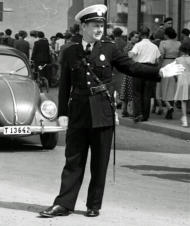
The image shows a municipal police officer equipped
with a baton and a saber directing traffic in Örebro
on Children’s Day in 1953. Photo: Örebro City
Archives, ID PS-232-0108.
However, as early as January 1, 1933, following a
1932 parliamentary decision, a State Police
Department was established under the command
of a State Police Superintendent stationed in
Stockholm.
The State Police Department was divided into the
Public Order Police, the Criminal Investigation Police,
and the Security Police.
The force eventually grew to 226 criminal
investigators and 306 public order officers.
The State Public Order Police could be deployed
anywhere in Sweden in the event of unrest. The State
Police was primarily intended to serve as
reinforcements for municipal police districts in rural
areas.
The rest of the time, the State Police carried out
routine police work in the cities where they were
stationed. In the late 1930s, following the outbreak of
World War II, a State Police Criminal Investigation
Department (Swedish: Rikskrim) was also
established, whose primary task was to assist the
regular municipal police in investigating serious
crimes.
On January 1, 1965, the entire Swedish police
force was nationalized. The three branches of the
system—police, prosecution, and
enforcement—were now completely separated from
one another, and three independent organizations
were created: the police service, the office of the
public prosecutor, and the enforcement service. As a
result, both the city attorneys and their rural
counterparts, the rural prosecutors, were abolished.
A regional police chief (Swedish: länspolischef)
became responsible for police operations within
each region (Swedish: Län). The county
administrative board (Swedish: Länsstyrelsen)
became the highest police authority in a county
(“Län”).
In connection with the nationalization, the National
Police Board (“Rikspolisstyrelsen”) was
established as the coordinating authority
for police operations.
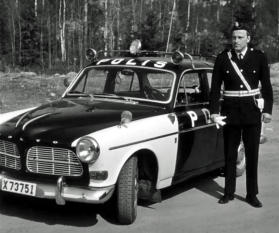
In 1967, police cars were painted with the
word “POLIS” (“POLICE.”) A national police
training academy was established in Solna
in 1965 to serve police officers throughout
the country.
The image shows a police officer and his
police car (Volvo Amazon) in Hälsingland
province, late 1960s/early 1970s. Photo:
Digital Bild in Söderhamn, ID: XTJ00114.
On January 1, 2015, the police force was
reorganized, and the 21 police agencies (one per
county (“Län”)) were merged into two separate
agencies: the Police Agency and the Security
Service.
For more information on the history of the police,
visit the following pages:
History of the Swedish Police and The Swedish Police
of Today
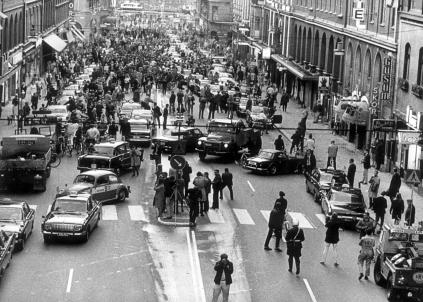
The Switch to Right-Hand Traffic in 1967
On September 3, 1967, at 5:00 a.m., Sweden
switched from driving on the left to driving on the
right. This process was called the Switch to Right-
Hand Traffic, also known as “H-Day” (the "H" stands
for "Högertrafik," Swedish for right-hand traffic.)
The change meant that all vehicle traffic, including
cyclists, would henceforth travel on the right side of
the road.
The first regulation mandating right-hand traffic in
Sweden was issued as early as 1718, but it did not
last long. In 1734, it was replaced by a new regulation
that instead mandated left-hand traffic.
The fact that Sweden had left-hand traffic posed no
problem until motor vehicle traffic began to expand
significantly, at which point proposals were put
forward to align with the traffic system dominant on
the European continent. Improved road safety from
an international perspective was the primary reason
for switching to right-hand traffic.
From the very beginning, Swedish automakers
built left-hand-drive cars so that they would be
ready for the switch to right-hand traffic that the
authorities had indicated would take place.
Furthermore, since right-hand traffic was the norm in
most of the countries to which Sweden exported its
cars, these vehicles had to be built with the steering
wheel on the left side.
As a result, the cars sold to Swedish drivers had
the steering wheel on the left side (as they do
today), even though we still drove on the left at the
time. The arrangement made passing other vehicles
more difficult and dangerous.
As early as 1927, a committee suggested that a
switch to right-hand traffic be studied. Several
suggestions for right-hand traffic were raised in the
Riksdag (the Parliament) during the 1930s and 1940s.
In 1954, a committee plainly and definitely proposed
that right-hand traffic be implemented. In 1955,
an advisory referendum was held, and the transition
to right-hand traffic was rejected.
On May 10, 1963, the Riksdag finally decided that
Sweden would switch to right-hand traffic at 5:00
a.m. on September 3, 1967.
Since all vehicles sold in Sweden up to that point had
the steering wheel on the left side, virtually all
vehicles were already equipped for right-hand traffic.
However, the buses were not designed for right-
hand traffic. They had been right-hand drive during
the era of left-hand traffic and had their boarding
and alighting doors on the left side, i.e., facing the
curb. They couldn't be used as is, as that would have
required passengers to board and alight in the
middle of the road.
A large portion had already been prepared, but a
significant portion of the funding for the transition
went to bus companies for retrofitting. Either the
newer buses were retrofitted or new buses were
purchased. Buses that were not retrofitted were
donated as a form of emergency aid to countries
with left-hand traffic, such as Pakistan.
Before the switch to driving on the right, the postal
service’s vehicles were left-hand drive, which made
it easy for the mail carrier to deliver mail to
mailboxes directly from the vehicle. However, since
the switch to driving on the right, postal vehicles are
typically right-handed to facilitate the delivery of
newspapers and mail.
Many interchanges and intersections had to be
rebuilt. Road signs, traffic signals, and lane markings
had to be relocated and modified.
In preparation for the switch to right-hand traffic
on September 3, 1967, black hexagonal signs bearing
a yellow “H” were put up. This was done to remind
drivers to keep to the right after “H-Day.”
At 4:50 a.m. on Sunday morning, September 3,
1967, all vehicles were to stop and remain stationary
on the left side of the road for 10 minutes. The
countdown to 5:00 a.m. was broadcast on the radio.
After this pause, all drivers then carefully moved over
to the right side of the road. Sweden thus switched
from driving on the left to driving on the right.
In the immediate period following the change, police
traffic monitoring was very intensive.
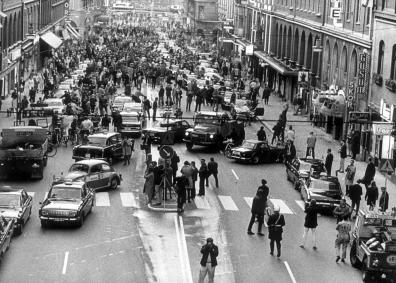
The image shows ongoing conversion to right-hand
traffic on Kungsgatan, downtown Stockholm, at 5:00
a.m. on September 3, 1967. Photo: Wikipedia.
The Unicameral Parliament of 1971
The old Parliament of the Four Estates was
abolished in 1866. The electoral reform was
adopted in December 1865. It took effect after the
conclusion of the parliamentary session on June 22,
1866.
With the reform, the estates-based representation
was replaced by a system with two separate
chambers, i.e., a bicameral parliament: the First
Chamber, elected by the county councils, and the
Second Chamber, elected in direct parliamentary
elections.
The bicameral Riksdag was replaced by a
unicameral Riksdag following an amendment to the
Riksdag Act in 1971. The Riksdag now consisted of a
single chamber with 350 members.
Three years later, in 1974, Sweden adopted both new
parliamentary rules of procedure and a new
constitution. The Constitution entrenched the ideas
of parliamentarism and accorded the Speaker a
prominent role in the formation of governments.
For the 1976 election, the voting age was lowered
from 20 to 18. At the same time, the number of
members of the parliament was reduced from
350 to 349.
In 1994, the Riksdag decided to extend the electoral
term from three to four years.
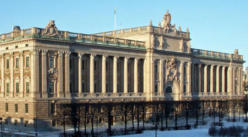
The Parliament
Building is the seat of
the Swedish
Parliament and is
located on
Helgeandsholmen in
downtown Stockholm.
The image shows the Parliament Building on
Helgeandsholmen in Stockholm. Photo: Wikipedia.
After the bicameral Riksdag was replaced by the
unicameral Riksdag in 1971, the parliament building
was refurbished to accommodate the new plenary
chamber. During the renovation, the Riksdag was
temporarily housed in the then-newly constructed
Kulturhuset on Sergels Torg. In 1975, the Riksdag
moved back to Helgeandsholmen.
New license plates on Swedish vehicles in
1973
Until 1973, every vehicle in Sweden was registered in
the county (“Län”) where it was based. In other
words, there was no national registry prior to 1973.
The county administrative board (Swedish:
Länstyrelsen) in each county maintained a registry of
vehicles in the county.
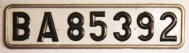
The license plate, therefore, consisted of the county
letter plus a serial number of up to five digits. Each
county in Sweden has a unique county letter, such as
“C” for Uppsala County, “D” for Södermanland
County, “E” for Östergötland County, and so on.
If a county had more than 99,999 registered vehicles,
the county code was extended by an A and, where
applicable, by a B. The City of Stockholm had many
registered vehicles and used the following different
county codes on its cars: A, AA, and AB, while
Stockholm County used B, BA,
and BB.
The image shows an example
of a license plate from Stockholm County prior to
1973 (BA85392). Image: Wikipedia.
It was fun with those old license plates that had the
county letter on them. On a road trip in Sweden,
people would wave to each other if they saw a car
with the same county letter.
On May 1, 1973, a centralized vehicle registration
system was introduced in Sweden, thereby
abolishing the system of county-specific license
plates.
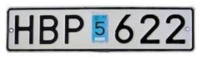
The new format consisted of three letters followed
by three numbers, such as HBP 622.
The transition to the new system took place on a
county-by-county basis, beginning in Uppsala County
as early as 1972. All vehicles in Sweden were issued
new license plates, not just
newly registered ones.
The image shows a Swedish
license plate (HBP622) with a
vehicle inspection sticker. The plate was issued after
1973 but before 2003.
The inspection sticker indicated that the vehicle had
passed the inspection, that the vehicle tax had been
paid, and that the vehicle had valid third-party motor
insurance. The inspection stickers were abolished in
2010.
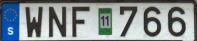
The so-called EU license plate was introduced in
Sweden on April 1, 2003, featuring a blue section
with the EU symbol and the country code letter “S.”
Starting in 2003, all newly registered vehicles in
Sweden were issued license plates bearing the EU
symbol.
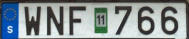
The image shows a license
plate from 2003 with an
inspection sticker and the EU
symbol. Image: Wikipedia.
License plates from 2019:
During the 2010s, it became clear that a new system
for vehicle registration numbers would be needed, as
the system used up to that point would not be
sufficient for all the new vehicles that would be
registered in the future. The solution was to
introduce a letter as the last character in the
registration number.
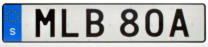
On February 16, 2017, the government made a
decision allowing the Swedish Transport Agency to
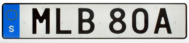
issue license plates where the last character is
alphanumeric (i.e., a number or a letter), such as
MLB 80A—that is, three letters, two numbers, and
one letter or number. The decision applied only to
newly registered vehicles. The new type of
registration number began to be used on January
16, 2019.
The image shows an
example of a license plate
from 2019 with a letter as the last character.
The 1980 Nuclear Power Referendum
An advisory referendum (non-binding) on nuclear
power in Sweden was held on March 23, 1980. The
referendum offered not just two options—YES or NO
to nuclear power—but three.
The referendum concerned three proposals known
as Option 1, Option 2, and Option 3.
The ballots of the three options all called for the
phase-out of nuclear power. What primarily set them
apart was the pace of the phase-out.
Option 3 proposed a phase-out within 10 years,
while the others proposed a pace that would be
feasible given the need for electricity to sustain
employment and welfare. Option 2 received the
most votes.
The results were 18.9 percent for Option 1 (phased
phase-out), 39.1 percent for Option 2 (phased
phase-out, public ownership, conservation, and
investment in renewable energy), and 38.7 percent
for Option 3 (phase-out within 10 years and
investment in renewable energy).
The Moderate Party supported Option 1, the Liberal
Party (now the Liberals) and the Social Democrats
supported Option 2, and the Center Party and the
VPK (now the Left Party) backed Option 3. The KDS,
now the Christian Democrats (which at that time
were not yet a party represented in the Parliament),
also backed Line 3.
The decision to hold a referendum was made in
response to growing awareness of the risks
associated with nuclear power following the 1979
Harrisburg accident and amid mounting opposition to
nuclear power in Sweden.
After the referendum, the Riksdag (the Parliament)
resolved to phase out all nuclear reactors by 2010.
In 1997, the Riksdag (1997:1320) made the decision
to gradually phase out nuclear power without
establishing a deadline.
However, on June 17, 2010, the Riksdag voted in
favor of allowing the construction of new reactors to
replace the existing ones, an option that was not
included in the nuclear power referendum.
In 2020, Sweden had six nuclear reactors in
operation.
Sweden's accession to the EU in 1995
On November 13, 1994, Sweden held a
consultative referendum on EU
membership. 52.3 percent voted in
favor of Swedish membership.
Following the referendum, Sweden joined the
European Union (EU) on January 1, 1995.
Sweden had been a member of EFTA (the European
Free Trade Association) since 1960. In 1987, Sweden
expressed its desire to join the European
Community’s (EC) single market. Following the fall of
the Berlin Wall in the fall of 1989, there was
increased discussion regarding Swedish EC
membership.
In July 1991, Prime Minister Ingvar Carlsson
submitted Sweden’s application for membership.
Finland joined the EU at the same time as Sweden.
The European Union (EU) is a union based on
treaties among 27 European countries and an
international organization with a uniquely high
degree of supranationality.
The European Union was established on November
1, 1993, but its history dates back to the founding of
the European Coal and Steel Community (ECSC) on July
23, 1952.
An Economic Community (EC) was established on
January 1, 1958, and just over ten years later, the
creation of a customs union was completed.
The Church of Sweden was separated
from the state in 2000
On January 1, 2000, the Church of Sweden
was formally separated from the state.
However, in reality, the separation was not fully
completed, as the Church of Sweden still enjoys
state-like privileges compared to other religious
communities and organizations.
The Act on the Church of Sweden (SFS 1998:1591)
is a Swedish law that, among other things, governs
the relationship between the Swedish state and the
Church of Sweden. The Act was enacted on
November 26, 1998, and entered into force on
January 1, 2000.
The law defines the Church of Sweden as an
Evangelical Lutheran denomination. The Church of
Sweden shall continue to be an open national
church, governed and led through cooperation
between a democratic organization and the church’s
clergy.
The congregation’s fundamental mission is defined
as conducting worship services, providing religious
education, and carrying out church welfare and
missionary work. The General Synod is designated as
the highest decision-making body.
Since 2000, the Church of Sweden has been
responsible for organizing the church elections,
which take place every four years.
The number of parishes has dropped by slightly
more than 1,100 since the Church of Sweden broke
away from the state in 2000.
Women's access to traditionally male-
dominated professions
Female police officers
Sweden’s first female police officers began serving
in 1908. The first women hired were nurses and were
known as “police sisters.” The police sisters’ duties
focused primarily on providing social and medical
assistance to women and children who, for various
reasons, had been taken into police custody. The
police sisters served in nursing attire instead of
police uniforms, and they were unarmed. However,
from the very beginning, they were granted the
protection and authority of a police officer—in
other words, they were police officers. For this
reason, they also wore the police insignia, namely a
police badge.
Starting in the 1940s, they began to be referred to
more and more as female police officers, even
though their official title was “police sister.” The title
“police sister” was abolished in 1954.
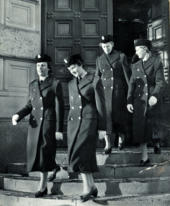
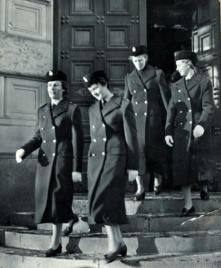
In the fall of 1957, 24 female police cadets were
admitted to the National Police Academy in
Stockholm. In January 1958, they began their duties
as uniformed officers and were assigned to various
districts to perform patrol
duties. Thus, starting that year,
female police officers began
patrolling in uniform. At that
time, the police force was still
under municipal jurisdiction.
The image shows female
Swedish police officers in
Stockholm in 1958. Photo:
Wikipedia.
In other words, in 1958, female police officers
graduated from the same police training program as
their male counterparts (prior to that, there had
been special courses for female police officers).
However, the idea that they would wear the same
uniform as the men was completely unthinkable. It
had to be clear from a distance which officers were
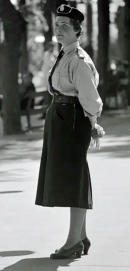
male and which were female. Such
considerations led to the exclusion
of pants for women. However, it
was recognized that wearing skirts on
patrol duty would be problematic
and inappropriate, so the skirt-pants
(culottes) were introduced.
The image shows a female police
officer in uniform wearing skirt-style
pants (culottes) circa 1955–1970.
Photo: Bo Trenter. Image: Nordic
Museum, ID: NMA.0110628.
In 1957, the first female police officers were hired in
Stockholm. In January of the following year, they
began their duties as patrol police officers. The
women had the same responsibilities as their male
counterparts but were equipped with batons instead
of sabers.
During the 1960s, female police officers participated
on a trial basis in regular surveillance and
investigative operations.
The nationalization of the police force in 1965:
Following the nationalization of the police force in
1965, the newly established Swedish National Police
Board decided to launch a pilot program assigning
special duties to female police officers. Under this
program, women hired by the police in 1969 and
thereafter should exclusively be placed in
investigation units or on other duties, excluding
them from patrols. They were not to perform
uniformed police duties; in other words, female police
officers were denied the right to wear a uniform.
In 1971, however, the Ministry of Justice approved a
request that female police officers be allowed to
perform patrol duties.
Since then, women in the police force have, in
principle, had the same duties, training, equipment,
and pay and benefits as their male colleagues. It was
not until 1971, however, that female police officers
began working under the same conditions as their
male colleagues and that uniformed female police
officers were allowed to patrol on the streets for the
first time.
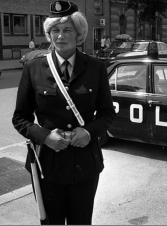
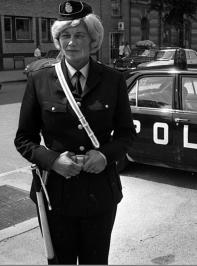
In other words, the ban on female police officers
wearing uniforms was lifted in
1971, and three years later, in
1974, they were also granted the
right to wear pants.
The image shows a female police
officer in uniform wearing pants
on June 13, 1974, in Örebro.
Photo: Roger Lundberg. Image:
Örebro County Museum, ID: OLM-
2012-8-11413.
Women in the Armed Forces
Women were formally admitted to all branches of the
Swedish Armed Forces in 1989, but until 1994,
women were required to intend to pursue officer
training to be eligible for military service at all.
Of those currently serving in the Swedish Armed
Forces, approximately 22 percent are women and
78 percent are men.
The first woman to complete (voluntary) military
service was Inger-Lena Hultberg, who served in
ground support with the Air Force in 1962. She was,
however, an exception. It would not be until 1980
that women were able to apply for certain positions
and training programs in the military.
The following year, in 1981, the Swedish Parliament
decided that both women and men should be eligible
for officer positions in all branches of the armed
forces. Women were permitted to serve as officers
and, later, also as soldiers and sailors.
Women were formally admitted to all branches of the
Armed Forces in 1989, but until 1994, women were
required to intend to pursue officer training to be
eligible for military service at all.
However, women have served in the Swedish Armed
Forces since the early 1900s
through voluntary defense services
such as the Blue Star, the Red Cross,
the Lotta Corps, and others.
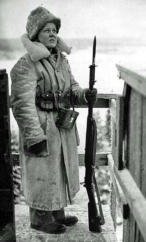
The photo shows a Swedish female
aircraft observer on duty in an air
observation tower, equipped with
field glasses, a loaded rifle, and an
ammunition belt during World War
II. They carried live ammunition
and were authorized to fire if
attacked. Photo: The Swedish Military Archives.
Ever since universal conscription was introduced
in 1901, it has been mandatory for all young men to
undergo military training; in other words, it was
compulsory to perform military service. Since 1980,
women have had the option to perform military
service on a voluntary basis. Since 1989, all positions
in the armed forces have been open to women,
including combat roles, and since 1994, it has also
been possible for women to perform military service
without undergoing subsequent officer training.
In 2010, conscription was suspended in favor of a
professional military. Since it was difficult to fill all
vacancies in the Armed Forces with professional
soldiers and sailors, conscription was reinstated in
2017, but now with a limited number of conscripts
each year.
Conscription, which was reinstated in 2017, now
applies to both men and women. The requirement
to register for conscription took effect on July 1,
2017, and the obligation to complete basic military
training was introduced on January 1, 2018.
Conscripts are now filling the vacancies that
previously existed in the professional military units,
enabling them to operate at full strength..
So, in 2018, conscription
in Sweden was expanded
to include both women
and men aged 18 for
basic training, i.e.,
gender-neutral
conscription.
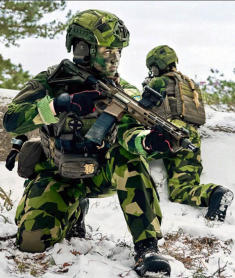
The image shows two
female Swedish soldiers,
March 2026. Photo:
Johanna Åkerberg Kassel.
Image: Swedish Armed
Forces.
Women Parish Ministers in the Church of
Sweden
As early as 1919, the issue of women’s eligibility to
become clergymen in Sweden was raised. It would be
nearly 40 years before women were admitted to the
priesthood.
Not until 1958 were the women first allowed to be
ordained as clergy in the Church of Sweden. In 1960,
the first female clergymen were ordained: Margit
Sahlin and Elisabeth Djurle Olander in the Diocese of
Stockholm, and Ingrid Persson in the Diocese of
Härnösand. In 1973, Dora Wikner became the first
woman to be ordained in the Diocese of Skara.
However, the decision to ordain women as
clergymen sparked controversy. The majority of the
church opposed the decision to allow women to
become clergy in 1958. The government pushed the
reform through. Since the Church of Sweden was still
a state church at that time, ultimate power lay in the
hands of politicians. For the government, it was a
matter of gender equality; for the church, it was a
matter of theology.
In 1957, the Church Assembly, the church’s highest
decision-making body, received a request from the
Swedish Parliament asking for its views on women
clergy. The response was negative.
The government rejected the decision and
subsequently introduced a bill in the Riksdag for a
new law, reminding the Church of Sweden that its
staff were government employees and that gender
discrimination was not permitted. An extraordinary
synod convened in 1958 then decided to allow the
ordination of women.
To mitigate criticism from opponents of women
clergy, the church adopted a so-called conscience
clause that gave clergy the right to follow their own
convictions if they did not feel able to work with
female colleagues. Nor could a bishop be compelled
to ordain a woman against his conscience. This
meant that the ordination of women was blocked in
certain dioceses. However, the conscience clause was
repealed by the Church Assembly in 1982.
In 1993, the Church Assembly also ruled that if a man
seeking ordination objects to his female colleagues,
he may be denied ordination.
The ordination of women has also been a
controversial issue in other countries. Denmark
ordained its first female pastor in 1948, Norway in
1961, and Finland in 1988. In the Evangelical
Lutheran Church in America (ELCA), the first woman
was ordained in 1970. The Roman Catholic Church
still opposes the ordination of women, as do the
Orthodox Churches.
Ingrid Persson (1912–2000) was one of the first
female clergy in Sweden. On Palm Sunday 1960, she
was ordained by the Church of Sweden in
Härnösand. Beginning in 1963, she served as an
assistant parish minister at Svartvik Church in the
Njurunda parish, just south of Sundsvall. When I was
confirmed in the mid-1960s, I attended catechism
sessions led by Ingrid Persson herself.